 Add to Chrome
 Add to Firefox
 Add to Edge
SOCO: Benchmarking Semantic Object Correspondence in Vision Foundation Models
Jun 01, 2026
Measuring structured object understanding in vision foundation models remains challenging due to inconsistent evaluation protocols and limited part-level supervision. Semantic correspondence (SC) evaluates this capability by testing whether object parts can be matched across instances and categories under large variations in appearance, viewpoint, and geometry. To enable a systematic SC evaluation, we introduce SOCO, a new benchmark for Semantic Object Correspondence that introduces a taxonomy of correspondence types and provides consistent, functionally meaningful keypoint annotations across 100 categories and over 1M correspondence pairs. In addition, SOCO includes keypoint language descriptions, enabling the evaluation of large vision-language models (LVLMs) and their fine-grained part-level understanding. Comprehensive experiments reveal that (i) vision foundation backbones encode strong semantic structure but transfer correspondences poorly across related categories and only partially capture object-part position, (ii) LVLMs are stronger at text-prompted part localization than at visual-reference cross-image matching, exposing a gap between language-grounded localization and fine-grained visual correspondence, and (iii) correspondence performance predicts performance on dense downstream tasks, including segmentation, tracking, 3D pose estimation, and 3D detection, more strongly than ImageNet classification. Together, these findings position SOCO as a benchmark for structured, part-level representation quality in vision and multimodal foundation models.

Category-Level 3D Correspondence in Camera Space via Morphable Object Priors
May 27, 2026Understanding 3D objects from images is fundamental to robotics and AR/VR applications. While recent work has made progress in category-level pose estimation, current representations fail to capture the fine-grained semantics needed for reasoning about object parts, functions, and interactions. In this work, we study category-level 3D correspondence in camera space -- predicting, from a single image, 3D locations that remain consistent across instances within a category -- and show that it can emerge without explicit correspondence supervision by learning a shared morphable object prior. To enable research in this direction, we introduce HouseCorr3D, the first large-scale benchmark for monocular category-level 3D correspondence with 178k images across 50 household object categories, 280 unique instances, and 3D keypoint annotations directly on CAD models. Crucially, HouseCorr3D provides amodal correspondence labels for occluded regions and explicit symmetry annotations, addressing key limitations of existing datasets. We further propose Morpheus, a method that learns morphable category-level shape priors by disentangling canonical shape, deformation, and object pose. Through this shared canonical grounding, semantically meaningful 3D correspondences in camera space emerge implicitly. These emerging 3D correspondences set a new state of the art on HouseCorr3D, demonstrating that semantic 3D object understanding can arise without direct correspondence supervision. Data and code are publicly available at https://github.com/GenIntel/HouseCorr3D.
TEDRA: Text-based Editing of Dynamic and Photoreal Actors
Aug 28, 2024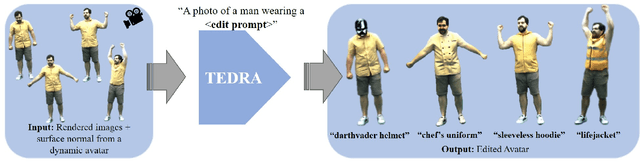
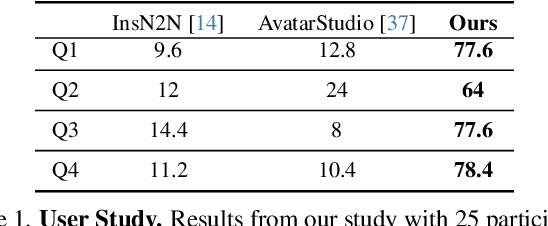
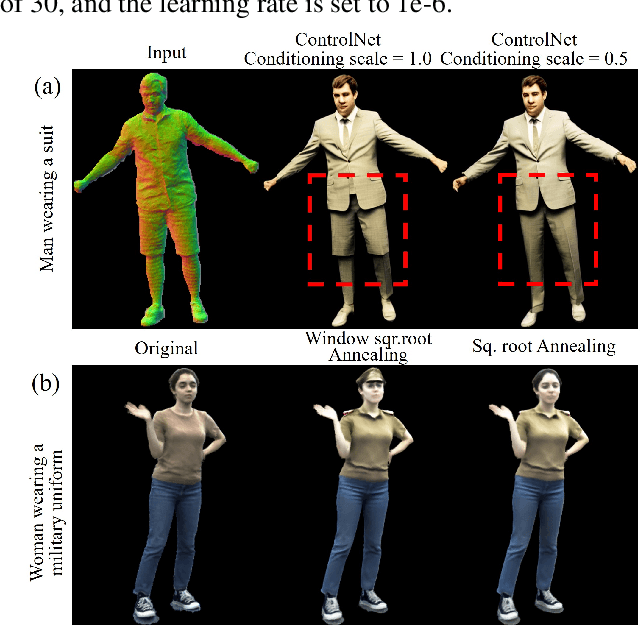
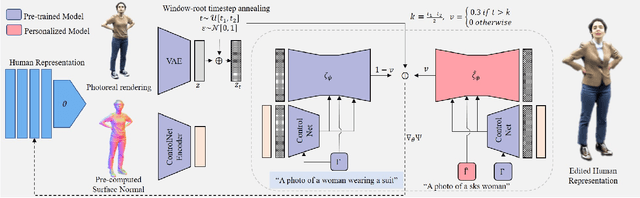
Over the past years, significant progress has been made in creating photorealistic and drivable 3D avatars solely from videos of real humans. However, a core remaining challenge is the fine-grained and user-friendly editing of clothing styles by means of textual descriptions. To this end, we present TEDRA, the first method allowing text-based edits of an avatar, which maintains the avatar's high fidelity, space-time coherency, as well as dynamics, and enables skeletal pose and view control. We begin by training a model to create a controllable and high-fidelity digital replica of the real actor. Next, we personalize a pretrained generative diffusion model by fine-tuning it on various frames of the real character captured from different camera angles, ensuring the digital representation faithfully captures the dynamics and movements of the real person. This two-stage process lays the foundation for our approach to dynamic human avatar editing. Utilizing this personalized diffusion model, we modify the dynamic avatar based on a provided text prompt using our Personalized Normal Aligned Score Distillation Sampling (PNA-SDS) within a model-based guidance framework. Additionally, we propose a time step annealing strategy to ensure high-quality edits. Our results demonstrate a clear improvement over prior work in functionality and visual quality.